Maximum Retail Price, commonly known as MRP, is the maximum price at which a product can be sold to the final consumer.
In pharma, Ayurvedic, nutraceutical, cosmetic and healthcare product businesses, MRP calculation is very important because it directly affects product margin, distributor interest, retailer profit, market competition and customer acceptance.
A wrong MRP can create two problems:
If MRP is too low, the company and trade channel may not get enough margin.
If MRP is too high, the product may become uncompetitive or may create trust issues.
Therefore, MRP should be calculated carefully after considering cost, GST, margins, transport, marketing expenses, trade margins and market competition.
Quick Answer
MRP is the maximum price payable by the final customer. It is inclusive of all taxes.
A practical MRP calculation includes:
Manufacturing cost
Packing cost
Company margin
C&F margin
Stockist margin
Retailer margin
Freight and transportation
Marketing expenses
Administrative expenses
Applicable GST
Market competition
DPCO/NPPA price control, where applicable
A simple formula is:
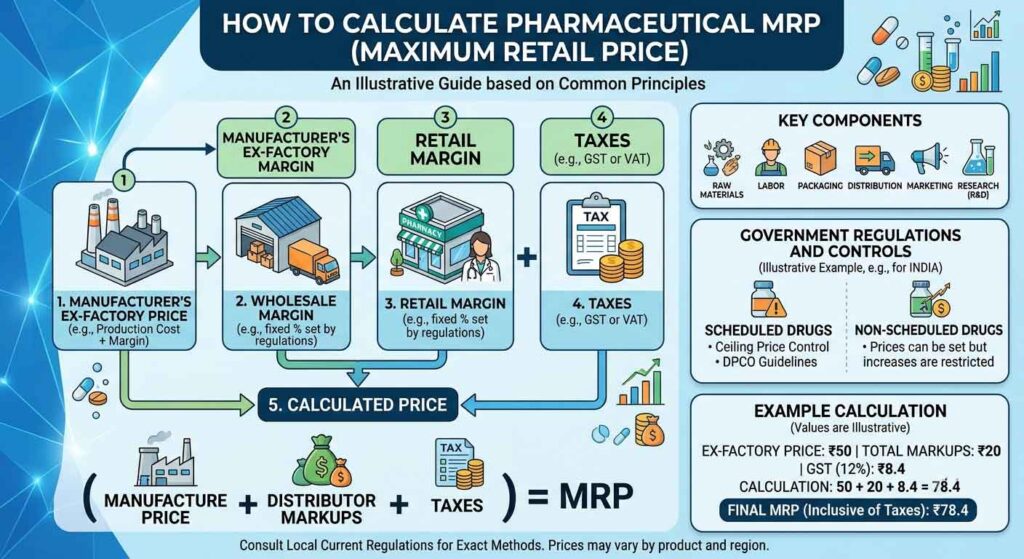
MRP = Total Cost + Company Profit + Channel Margins + Marketing Expenses + Freight + Applicable GST
However, in actual pharma pricing, MRP is usually finalized by comparing cost-based calculation with market price, competitor MRP, margin structure and regulatory limits.
What Is MRP?
MRP stands for Maximum Retail Price.
It is the highest price printed on the product pack at which the product can be sold to the final consumer.
MRP includes:
Product cost
Trade margin
Distribution cost
Marketing cost
GST and applicable taxes
Company profit
Other business expenses
No retailer should sell a product above the printed MRP.
Is GST Included in MRP?
Yes. MRP is inclusive of GST and all applicable taxes.
For example, if the printed MRP is ₹100, the customer should not be charged ₹100 plus GST separately.
The final customer price cannot exceed the printed MRP.
Why MRP Calculation Is Important in Pharma
MRP calculation is important because it affects:
Company profitability
PCD franchise margin
Distributor margin
Stockist margin
Retailer margin
Doctor promotion budget
Market competitiveness
Customer affordability
Product positioning
GST and billing structure
Long-term sales growth
In pharma franchise and third-party manufacturing, MRP also helps decide net rate, PTR, PTS and trade margin.
Company margin = 25% of ₹41.30 Company margin = ₹10.33
Company price = ₹41.30 + ₹10.33 Company price = ₹51.63
Step 4: Add C&F Margin
C&F margin = 6% of ₹51.63 C&F margin = ₹3.10
Price after C&F margin = ₹54.73
Step 5: Add Stockist Margin
Stockist margin = 10% of ₹54.73 Stockist margin = ₹5.47
Price after stockist margin = ₹60.20
Step 6: Add Retailer Margin
Retailer margin = 20% of ₹60.20 Retailer margin = ₹12.04
Price before GST = ₹72.24
Step 7: Add GST
GST = 5% of ₹72.24 GST amount = ₹3.61
Final price = ₹75.85
Rounded MRP = ₹76
So, in this example, the company may print MRP around ₹76, or round it to a market-friendly value such as ₹75, ₹80 or ₹85 depending on competitor pricing and business strategy.
Important: Markup and Margin Are Different
Many people make mistakes because they treat markup and margin as the same thing.
Markup
Markup is calculated on cost.
Example:
Cost = ₹100 Markup = 20%
Selling price = ₹120
Margin
Margin is calculated on selling price.
Example:
Selling price = ₹125 Cost = ₹100
Margin = ₹25 Margin percentage = 20%
So, when calculating MRP, clearly decide whether you are using markup or margin.
Pharma MRP Is Often Market-Based
In pharma, MRP is not always calculated only by cost.
Companies also check:
Competitor MRP
Product category
Brand positioning
Doctor acceptance
Patient affordability
Trade margin
Product quality
Promotional expense
Net rate feasibility
DPCO status
Market demand
For example, two products may have similar manufacturing cost but different MRP because of brand value, packing, market positioning and promotional strategy.
MRP for DPCO-Controlled Medicines
If a medicine is under price control, the company cannot freely fix MRP.
For scheduled formulations or price-controlled products, NPPA ceiling price or retail price must be checked.
In such cases:
MRP should not exceed the permitted ceiling price plus applicable taxes, where applicable.
Before fixing MRP of any allopathic medicine, check whether the product is under DPCO/NPPA price control.
Difference Between MRP, PTR and PTS
MRP
MRP is Maximum Retail Price.
It is the highest price payable by the final consumer.
PTR
PTR means Price to Retailer.
It is the price at which retailer purchases from stockist or distributor.
PTS
PTS means Price to Stockist.
It is the price at which stockist purchases from company or C&F.
Simple Difference
Term
Meaning
Used For
MRP
Maximum Retail Price
Final customer price
PTR
Price to Retailer
Retailer purchase price
PTS
Price to Stockist
Stockist purchase price
Net Rate
Company billing or agreed supply rate
Franchise/distributor/company billing
MRP is printed on the product. PTR, PTS and net rate are trade calculations.
How to Decide MRP From PTR and Retailer Margin
Sometimes companies calculate MRP from desired retailer margin.
Formula:
MRP excluding GST = PTR ÷ (1 – Retailer Margin %)
Then add GST to get GST-inclusive MRP.
Example:
PTR before GST = ₹80 Retailer margin = 20%
MRP before GST = 80 ÷ 0.80 MRP before GST = ₹100
If GST is 5%:
MRP = ₹105
How to Decide PTR From MRP
Formula:
PTR before GST = MRP before GST × (1 – Retailer Margin %)
Example:
MRP including GST = ₹105 GST = 5%
MRP before GST = ₹100
Retailer margin = 20%
PTR before GST = 100 × 0.80 PTR before GST = ₹80
Common MRP Calculation Mistakes
Avoid these mistakes:
Forgetting that MRP includes GST
Charging GST above MRP
Ignoring DPCO/NPPA price control
Not checking competitor MRP
Adding unrealistic trade margin
Confusing margin with markup
Ignoring freight cost
Ignoring marketing expense
Not calculating expiry and replacement risk
Keeping MRP too low
Keeping MRP too high
Not checking GST rate product-wise
Not considering retailer and stockist interest
Copying competitor MRP blindly
Not updating MRP after cost changes
What Is a Good MRP?
A good MRP should be:
Competitive in market
Profitable for company
Attractive for retailer
Practical for distributor
Acceptable to customer
Compliant with law
Suitable for product quality
Sustainable for long-term business
MRP should not be fixed only by multiplying manufacturing cost.
Why Customer Pays Much More Than Manufacturing Cost
Customers may pay more than manufacturing cost because final MRP includes:
Manufacturing cost
Packing cost
Company profit
GST
Marketing cost
Distributor margin
Retailer margin
Freight
Expiry risk
Staff cost
Promotion cost
Business overheads
This is why the final customer price may look much higher than factory cost.
MRP Calculation for Pharma Franchise
In pharma franchise business, MRP is important because it decides the margin available to franchise partners.
Franchise companies should calculate:
Manufacturing cost
Net rate
GST
Franchise margin
Doctor promotion expense
Stockist margin
Retailer margin
Market competition
Product demand
A product with very high MRP but poor market acceptance may not sell well.
A product with very low MRP may not give enough margin for promotion.
Balance is important.
MRP Calculation for Third-Party Manufacturing
In third-party manufacturing, MRP should be finalized before printing packaging material.
Before finalizing artwork, check:
Product cost
Batch size
Packing cost
GST rate
Competitor MRP
DPCO status
Trade margin
Promotional expense
Net rate
Product positioning
Once printed, changing MRP may waste packing material and create compliance issues.
MRP Calculation for Ayurvedic and Nutraceutical Products
For Ayurvedic and nutraceutical products, MRP should be based on:
Ingredient cost
Packing cost
GST rate
Market competition
Brand positioning
Retailer margin
Distributor margin
Online selling price
Consumer affordability
Promotional expense
Premium packaging and strong branding can support higher MRP, but product quality and customer trust are still essential.
Practical Checklist Before Finalizing MRP
Before printing MRP, check:
Manufacturing cost
Packing cost
GST rate
DPCO/NPPA applicability
Competitor MRP
Retailer margin
Stockist margin
Distributor margin
Company profit
Freight
Marketing expense
Replacement risk
Online discount strategy
Trade scheme
Product positioning
Customer affordability
Final Thoughts
MRP calculation is not only a mathematical calculation. It is a business decision.
A good MRP should cover cost, GST, trade margins, marketing expenses, transport, company profit and risk while remaining competitive in the market.
In pharma, MRP must also be checked from a regulatory point of view, especially for price-controlled medicines.
Before finalizing MRP, always compare your calculation with competitor products, expected trade margin, GST rate and customer affordability.
Correct MRP helps create a profitable and sustainable product. Wrong MRP can reduce sales, disturb trade margins or create compliance problems.
Frequently Asked Questions
1. What is MRP?
MRP means Maximum Retail Price. It is the maximum price at which a product can be sold to the final consumer.
2. Is GST included in MRP?
Yes. MRP is inclusive of GST and all applicable taxes.
3. Can retailer charge GST above MRP?
No. GST cannot be charged over and above printed MRP.
4. How is MRP calculated?
MRP is calculated by adding manufacturing cost, packing cost, company margin, channel margins, freight, marketing expense, other expenses and applicable GST.
5. Is MRP the same as PTR?
No. MRP is the final customer price. PTR is the price to retailer.
6. Is MRP the same as PTS?
No. PTS is price to stockist, while MRP is maximum retail price for the customer.
7. Can company fix any MRP for medicine?
Not always. If the medicine is under DPCO/NPPA price control, MRP must follow applicable ceiling or retail price rules.
8. What happens if MRP is too high?
The product may become uncompetitive and difficult to sell.
9. What happens if MRP is too low?
The company, distributor, stockist or retailer may not get enough margin.
10. Should MRP be rounded off?
Yes, companies often round MRP to a market-friendly number, but it should remain compliant and commercially practical.
Looking for Ayurvedic Franchise or Distribution Opportunities?
Looking to start an Ayurvedic franchise, become a distributor, or launch your own herbal product range?
Elzac Herbal India offers:
Ayurvedic & Herbal Product Range
Franchise & Distribution Opportunities
Third-Party Manufacturing Services
Product Development Support
Marketing Guidance
PAN India Business Opportunities
Whether you are an entrepreneur, retailer, distributor, or healthcare professional, our team can help you explore the right business opportunity in the growing Ayurvedic sector.
Ajay Kamboj is an entrepreneur and business owners associated with many Ayurvedic and Pharmaceutical start-ups. With years of experience in Ayurvedic product marketing, pharmaceutical distribution, franchise development, and client relationship management, he regularly shares practical business insights based on real-world experiences. His articles focus on business growth, entrepreneurship, customer management, and lessons learned from the healthcare and wellness industry.
5 responses to “How to Calculate Maximum Retail Price (MRP) in Pharma”
For Example if I purchased pen in banglore @ Rs/- 20.per pc than my friend also purchase that pen @ same price in mumbai. It is MRP rate. you have 10 middlemans. 30% raw material , 8% tax , than 20% profit of retailar. How you distribute this price for each process.
As per your comment
30% raw material cost (we are considering it at total manufacturing cost) = 6/- as per MRP
8% Tax i.e. 1.48/-
Now MRP without Tax is 18.52/-
20% retailer Margin i.e 3.09/-
Amount left after retailer margin is 15.43/-
Now we have 15.43-6 = 9.43/-
From this 9.43/-, we will take profit for us and distribute to 10 middlemen depend at important of middleman like stockist 8-10%, CNF 5-6% etc
As per your comment
30% raw material cost (we are considering it at total manufacturing cost) = 6/- as per MRP
8% Tax i.e. 1.48/-
Now MRP without Tax is 18.52/-
20% retailer Margin i.e 3.09/-
Amount left after retailer margin is 15.43/-
Now we have 15.43-6 = 9.43/-
From this 9.43/-, we will take profit for us and distribute to 10 middlemen depend at important of middleman like stockist 8-10%, CNF 5-6% etc
Sir i am herbal medicine manufacturer having all proprietary medicines . Now i am looking to start selling my products how much margin will be appropriate to Distributor, Stockist, Retailer . As we are a new company distributors are demanding around 50 to 70 %. What is the actual thing. Please guide me.
percent margin depend at marketing type you prefer to go. If you have own MR then margin will be just like 10% or 15% but if you just want to supply goods to distributors and remaining work at distributors to supply, market and collection of payment then margin is more. Distributor will demand any amount of percent, it’s up to you to decide at which margin you will supply to them. Fix margin as per your costing and supply…




For Example if I purchased pen in banglore @ Rs/- 20.per pc than my friend also purchase that pen @ same price in mumbai. It is MRP rate. you have 10 middlemans. 30% raw material , 8% tax , than 20% profit of retailar. How you distribute this price for each process.
As per your comment
30% raw material cost (we are considering it at total manufacturing cost) = 6/- as per MRP
8% Tax i.e. 1.48/-
Now MRP without Tax is 18.52/-
20% retailer Margin i.e 3.09/-
Amount left after retailer margin is 15.43/-
Now we have 15.43-6 = 9.43/-
From this 9.43/-, we will take profit for us and distribute to 10 middlemen depend at important of middleman like stockist 8-10%, CNF 5-6% etc
As per your comment
30% raw material cost (we are considering it at total manufacturing cost) = 6/- as per MRP
8% Tax i.e. 1.48/-
Now MRP without Tax is 18.52/-
20% retailer Margin i.e 3.09/-
Amount left after retailer margin is 15.43/-
Now we have 15.43-6 = 9.43/-
From this 9.43/-, we will take profit for us and distribute to 10 middlemen depend at important of middleman like stockist 8-10%, CNF 5-6% etc
Sir i am herbal medicine manufacturer having all proprietary medicines . Now i am looking to start selling my products how much margin will be appropriate to Distributor, Stockist, Retailer . As we are a new company distributors are demanding around 50 to 70 %. What is the actual thing. Please guide me.
percent margin depend at marketing type you prefer to go. If you have own MR then margin will be just like 10% or 15% but if you just want to supply goods to distributors and remaining work at distributors to supply, market and collection of payment then margin is more. Distributor will demand any amount of percent, it’s up to you to decide at which margin you will supply to them. Fix margin as per your costing and supply…