Net Rate + Freight + Packing Charges + Non-creditable Taxes + Handling + Other Direct Expenses
Net operating profit is:
Net Profit = Gross Profit − Marketing Expenses − Salaries − Travel − Rent − Credit Cost − Expiry and Other Overheads
Always calculate profit on the price at which you actually sell—not on MRP.
Important Pharma Pricing Terms
1. Maximum Retail Price
MRP means Maximum Retail Price.
It is the maximum amount that can be charged from the final consumer for a pre-packed product.
MRP is inclusive of:
GST
Other applicable taxes
Retail margin
Distribution expenses
Company margin
A retailer may sell below MRP but cannot charge GST separately over the printed MRP.
2. Net Rate
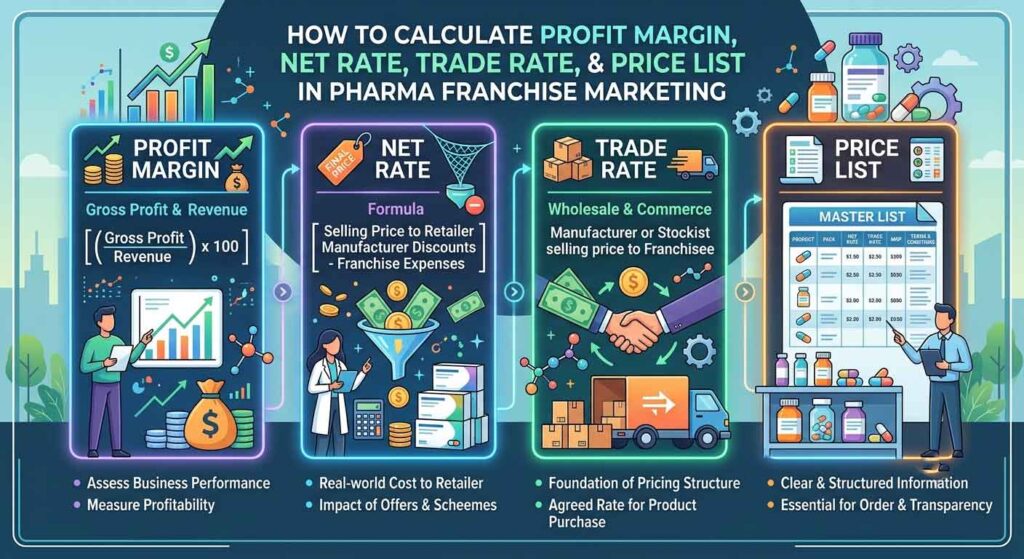
Net rate is the price at which a PCD or pharma franchise company supplies a product to its franchise partner.
A price list should clearly state whether the net rate is:
Exclusive of GST
Inclusive of GST
Ex-factory
Freight paid
Freight extra
Subject to packing charges
Subject to minimum order quantity
In most pharma franchise price lists, net rate is quoted excluding GST and freight, but this should never be assumed without checking the company’s terms.
3. Landed Cost
Landed cost is the actual cost of bringing the product into your stock.
Formula
Landed Cost = Net Rate + Freight per Pack + Packing/Forwarding + Non-creditable Expenses
Where GST input credit is legally available and correctly claimed, recoverable GST should not normally be treated as a permanent product cost.
Where input tax credit is not available, the tax becomes part of the cost.
4. Price to Stockist
Price to Stockist is commonly abbreviated as PTS.
It is the price at which the company, super stockist or franchise distributor supplies the product to a stockist or wholesaler.
PTS should normally be mentioned excluding GST unless the price list clearly says otherwise.
5. Price to Retailer
Price to Retailer is commonly abbreviated as PTR.
It is the price at which a stockist, distributor or franchise partner supplies the product to the retail pharmacy.
The retailer adds its margin and sells the product to the consumer at or below MRP.
Therefore, a price list should not contain only the words “trade rate.”
It should clearly mention:
PTS
PTR
GST status
Scheme
Freight terms
Margin basis
7. Retailer Margin
Retailer margin is the earning available to the chemist or pharmacy.
It may be calculated either:
As markup on PTR, or
As discount from MRP
These methods produce different results.
8. Stockist Margin
Stockist margin is the difference between PTR and PTS after considering the agreed calculation method.
9. Franchisee Margin
Franchisee margin is the difference between the franchisee’s selling price and landed cost.
It is not automatically equal to MRP minus net rate.
Difference Between Profit, Margin and Markup
These terms should not be used interchangeably.
Suppose:
Purchase cost: ₹50
Selling price: ₹75
Profit: ₹25
Profit Amount
Profit = Selling Price − Cost
₹75 − ₹50 = ₹25
Markup Percentage
Markup is calculated on cost:
Markup % = Profit ÷ Cost × 100
₹25 ÷ ₹50 × 100 = 50%
Profit-Margin Percentage
Profit margin is calculated on selling price:
Profit Margin % = Profit ÷ Selling Price × 100
₹25 ÷ ₹75 × 100 = 33.33%
Therefore:
Markup is 50%
Margin is 33.33%
Although the profit amount is the same, the percentages are different.
How a Pharma Company Calculates Its Net Rate
A pharma marketing company should first calculate its total cost.
Total Company Cost per Pack
The total cost may include:
Third-party manufacturing rate
Raw-material cost, for a manufacturer
Packing-material cost
Conversion charges
Testing charges
Artwork and development
Inward freight
Warehouse cost
Salary allocation
Administrative expenses
Samples
Promotional-material allocation
Finance cost
Expiry and return provision
Regulatory expenses
Company overheads
Formula
Total Cost = Product Purchase Cost + Direct Expenses + Allocated Overheads
The company can then use either a markup method or a margin method.
Net Rate Using Markup
If total cost is ₹60 and the company wants a 25% markup:
Net Rate = Cost × (1 + Markup)
₹60 × 1.25 = ₹75
Net Rate Using Desired Gross Margin
If total cost is ₹60 and the company wants a 25% gross margin on the selling price:
Net Rate = Cost ÷ (1 − Desired Margin)
₹60 ÷ 0.75 = ₹80
Therefore:
A 25% markup gives a selling price of ₹75.
A 25% margin gives a selling price of ₹80.
Confusing these two calculations can reduce the company’s expected profit.
How to Remove GST From MRP
Because MRP is inclusive of GST, first remove GST before calculating trade margins on a tax-exclusive basis.
Formula
MRP excluding GST = MRP ÷ (1 + GST Rate)
Suppose:
Printed MRP: ₹105
GST rate: 5%
MRP excluding GST = ₹105 ÷ 1.05 = ₹100
Two Methods of Calculating Retailer Margin
The parties must decide whether margin means:
Markup on purchase price, or
Discount from MRP
Method 1: Margin as Markup on PTR
Suppose:
MRP excluding GST: ₹100
Retailer margin: 20% on PTR
Formula
PTR = MRP excluding GST ÷ 1.20
PTR = ₹100 ÷ 1.20 = ₹83.33
Retailer’s gross earning excluding GST:
₹100 − ₹83.33 = ₹16.67
The retailer earns ₹16.67, which is:
20% of PTR, but
16.67% of MRP excluding GST
Method 2: Margin as Discount From MRP
Suppose the agreement says the retailer receives a 20% discount from MRP excluding GST.
Formula
PTR = MRP excluding GST × 80%
PTR = ₹100 × 0.80 = ₹80
Retailer’s gross earnings:
₹100 − ₹80 = ₹20
The result differs from the markup method.
Therefore, the price list should state:
“20% margin on PTR,” or
“20% discount from MRP”
It should not simply say “retailer margin 20%.”
DPCO Retailer-Margin Calculation
For scheduled formulations, NPPA’s market-based ceiling-price calculation adds a 16% margin to the average PTR.
In simplified form:
Ceiling Price excluding applicable tax = Average PTR × 1.16
Therefore:
Average PTR = Ceiling Price ÷ 1.16
If the ceiling price excluding tax is ₹116:
PTR = ₹116 ÷ 1.16 = ₹100
This does not mean the retailer margin is 16% of ₹116. It means the ceiling price is 16% above the PTR used in the calculation.
Manufacturers must check the latest NPPA ceiling or retail price before finalising MRP for a scheduled formulation. NPPA provides the Pharma Sahi Daam price-checking facility for scheduled and non-scheduled products.
How to Calculate Price to Stockist
Suppose:
PTR excluding GST: ₹83.33
Stockist margin: 10% on PTS
Formula
PTS = PTR ÷ 1.10
PTS = ₹83.33 ÷ 1.10 = ₹75.76
Stockist’s gross earning:
₹83.33 − ₹75.76 = ₹7.57
This is 10% of the stockist’s purchase price of ₹75.76.
When Stockist Margin Is a Discount on PTR
If the agreement provides a 10% discount from PTR:
PTS = PTR × 90%
₹83.33 × 0.90 = ₹75
Again, the two calculation methods produce different results.
The printed MRP must also provide the agreed downstream retailer or stockist margin and remain within any applicable NPPA ceiling.
How to Calculate MRP Backwards
Suppose:
Required PTS: ₹60
Stockist margin: 10% on PTS
Retailer margin: 20% on PTR
GST: 5%
Step 1: Calculate PTR
PTR = ₹60 × 1.10 = ₹66
Step 2: Calculate Tax-Exclusive MRP
MRP excluding GST = ₹66 × 1.20 = ₹79.20
Step 3: Add GST
MRP including GST = ₹79.20 × 1.05 = ₹83.16
A commercially suitable rounded MRP may be selected only after confirming:
NPPA restrictions
Competitor prices
Pack declarations
Consumer affordability
Applicable tax
Company pricing policy
Scheduled and Non-Scheduled Formulations
Scheduled Formulations
Scheduled formulations are subject to NPPA ceiling-price control under DPCO.
The manufacturer should:
Check the current ceiling price.
Calculate pack price correctly.
Add applicable tax only as permitted.
Keep MRP within the legal ceiling.
Follow current NPPA notifications.
Obtain prior price approval where required for a qualifying new drug.
NPPA continues to issue and revise scheduled-formulation ceiling and retail prices under DPCO 2013.
Non-Scheduled Formulations
Manufacturers generally determine the initial price of non-scheduled formulations, subject to:
DPCO monitoring
Applicable annual increase restrictions
Public-interest orders
Competition
Consumer laws
GST
Legal Metrology
Other pricing directions
Do not assume that a non-scheduled medicine is completely outside NPPA monitoring. NPPA’s official FAQ states that it monitors such prices and can take corrective measures where warranted.
Retailer and Stockist Margins Are Not Universal
The commonly discussed trade structure is sometimes:
Retailer margin: approximately 20%
Stockist margin: approximately 10%
However, this is not a universal mandatory formula for every non-scheduled medicine.
Actual terms may vary according to:
Product category
Company
Competition
Hospital supply
Generic or branded market
OTC product
PCD model
Institutional sale
State market
Product movement
Credit period
Scheme
The agreed calculation basis must be written into the price list or distribution agreement.
Promotional Expenses and UCPMP Compliance
UCPMP 2024 states that pharmaceutical companies and their agents—including distributors, wholesalers and retailers—should not offer gifts or pecuniary benefits for the personal benefit of healthcare professionals. It also restricts travel, hospitality and monetary grants except in limited permitted circumstances.
Permissible marketing-cost heads may include:
Product literature
Approved visual aids
Compliant samples
Field-force salary
Travel for genuine sales work
Digital promotion
Product training
Approved conferences or educational activities
Customer-service systems
Distributor meetings
Brand communication
Pricing should not be designed to fund prohibited inducements.
Medical Samples
Free medical samples are different from trade schemes.
Samples should be:
Properly labelled
Accounted for
Not sold
Distributed under company policy
Compliant with UCPMP
Included in marketing-cost calculation
The UCPMP portal’s official FAQ states that free samples should be marked “Free medical sample—not for sale” and provides a monetary limit linked to annual domestic sales.
Recommended Pharma Price-List Format
A professional PCD price list should include:
Column
Purpose
Product name
Brand name
Composition
Generic ingredients and strength
Dosage form
Tablet, capsule, syrup, injection etc.
Pack size
10×10, 100 ml, 30 capsules etc.
Net rate
Franchise purchase rate
GST
Applicable tax rate
Scheme
Free goods or discount
Effective net rate
Rate after scheme
PTS
Price to stockist
PTR
Price to retailer
MRP
Maximum retail price inclusive of taxes
MOQ
Minimum order quantity
Freight
Paid or extra
Promotional support
Visual aid, samples etc.
Product status
Scheduled/non-scheduled, where relevant
Sample Price List
Product
Pack
Net rate excl. GST
Scheme
Effective rate
PTS excl. GST
PTR excl. GST
MRP incl. GST
ABC Tablets
10×10
₹40
10+1
₹36.36
₹75.76
₹83.33
₹112
DEF Syrup
100 ml
₹28
Nil
₹28
₹54.55
₹60
₹80.64
GHI Capsules
10×10
₹55
5+1
₹45.83
₹82.65
₹90.91
₹122.18
These are mathematical examples only. Actual MRP and trade prices must be confirmed against product costs, GST classification, current NPPA requirements and commercial terms.
The company offering the lowest printed net rate may not provide the best overall business margin.
Direct Retailer Supply vs Stockist Route
Direct to Retailer
Advantages:
Higher contribution
Direct market control
Better retailer relationship
Disadvantages:
More billing
More collection work
More delivery cost
Higher credit risk
Greater field-force requirement
Through Stockist
Advantages:
Wider distribution
Lower delivery burden
Consolidated billing
Better local availability
Disadvantages:
Stockist margin must be provided.
Franchisee contribution is lower.
Less direct control over retailers.
The correct model depends on market size and sales volume.
Why High MRP Does Not Guarantee High Profit
A high MRP may appear attractive, but it can create problems such as:
Difficult retailer acceptance
Patient resistance
Excessive discount demand
Low prescription conversion
NPPA risk
Poor repeat sale
Competition from cheaper brands
Higher expiry
A sustainable product should offer:
Reasonable MRP
Acceptable retailer margin
Adequate franchise contribution
Competitive patient price
Consistent product quality
Repeat demand
Important Cost Provisions
A franchisee should provide for the following before calculating profit:
Marketing Cost
Visual aids
Samples
Product cards
Digital promotion
Field work
Staff Cost
Medical representative salary
Incentive
Travel allowance
Office staff
Distribution Cost
Freight
Courier
Local delivery
Packing
Finance Cost
Credit period
Delayed payments
Bank interest
Working-capital borrowing
Product Loss
Expiry
Damage
Leakage
Recall
Unsold stock
Replacement
Administrative Cost
Rent
Electricity
GST filing
Accountant
Software
Telephone
Licence renewal
Practical Profit Calculator
Use the following structure for each product.
Item
Amount
Net rate excluding GST
₹_____
Scheme-adjusted rate
₹_____
Freight per pack
₹_____
Packing/handling
₹_____
Effective landed cost
₹_____
Selling price excluding GST
₹_____
Gross contribution
₹_____
Marketing cost per pack
₹_____
Credit and expiry provision
₹_____
Net contribution per pack
₹_____
Monthly quantity
_____
Monthly product contribution
₹_____
Common Pricing Mistakes
Avoid these mistakes:
Treating MRP minus net rate as profit
Adding GST over MRP
Treating GST input credit as permanent cost
Confusing markup with margin
Assuming trade rate always means PTS
Using a fixed 70% of MRP formula
Assuming every retailer margin is 20%
Ignoring freight
Ignoring product schemes
Calling 10+1 a 10% discount
Ignoring credit cost
Ignoring expiry
Calculating profit on unsold stock
Comparing price lists only by net rate
Using prohibited gifts and tours as marketing-cost heads
Fixing MRP without checking NPPA
Printing MRP before verifying GST
Quoting prices without stating whether GST is included
Recommended Price-List Notes
A price list should clearly state:
Rates are exclusive or inclusive of GST.
GST will be charged at the applicable rate.
Freight is paid or extra.
Schemes are subject to company policy.
PTR and PTS are exclusive or inclusive of GST.
MRP includes applicable taxes.
Rates may change with raw-material and regulatory changes.
Scheduled products remain subject to NPPA prices.
Orders are subject to minimum quantity.
Expiry and replacement terms apply as per agreement.
Credit terms require written approval.
Practical Pricing Procedure for a Franchisee
Follow this sequence:
Obtain the latest company price list.
Confirm whether net rates exclude GST.
Check freight and packing terms.
Calculate scheme-adjusted net rate.
Calculate landed cost.
Remove GST from MRP.
confirm the margin calculation method.
Calculate PTR.
Calculate PTS.
Calculate franchise contribution.
Deduct field-force and marketing cost.
Add expiry and credit provision.
Calculate break-even sales.
Compare with competitors.
Finalise commercial rates in writing.
Final Answer
Profit in pharma franchise marketing is not calculated merely by subtracting net rate from MRP.
The correct calculation begins with:
MRP excluding GST
PTR
PTS
Scheme-adjusted net rate
Freight
Effective landed cost
Actual selling price
The most important formulas are:
Profit = Selling Price − Landed Cost
Profit Margin % = Profit ÷ Selling Price × 100
Markup % = Profit ÷ Landed Cost × 100
Effective Rate for Free Scheme = Rate × Paid Quantity ÷ Total Quantity
Break-Even Quantity = Fixed Expenses ÷ Contribution per Pack
A professional price list should separately mention:
Net rate
GST
Scheme
Effective rate
PTS
PTR
MRP
Freight
Minimum quantity
There is no universal rule that every non-scheduled pharma product must provide exactly 20% retailer and 10% stockist margin. The commercial structure should be clearly agreed upon and should comply with NPPA, GST, Legal Metrology and UCPMP requirements.
Frequently Asked Questions
1. What is net rate in pharma franchise?
Net rate is the price at which the franchise company supplies the product to the franchise partner, usually before GST and freight unless otherwise mentioned.
2. What is PTR?
PTR means Price to Retailer—the price at which a product is supplied to a retail pharmacy.
3. What is PTS?
PTS means Price to Stockist—the price at which the product is supplied to a stockist or wholesaler.
4. Is trade rate the same as PTR?
Not always. Some companies use trade rate for PTR, while others use it for PTS or distributor rate.
5. Is MRP inclusive of GST?
Yes. MRP is inclusive of applicable taxes, including GST.
6. Can GST be charged over MRP?
No. A consumer should not be charged GST separately over the printed MRP.
7. How is profit margin calculated?
Profit margin is profit divided by selling price, multiplied by 100.
8. How is markup calculated?
Markup is profit divided by cost, multiplied by 100.
9. Is a 10+1 scheme equal to a 10% discount?
No. The effective discount from a 10+1 scheme is approximately 9.09%.
10. Is retailer margin always 20%?
No. It depends on the product, company, price-control status and commercial agreement.
11. Is stockist margin always 10%?
No. Ten per cent is a commonly discussed market figure for some products, not a compulsory universal margin.
12. Should recoverable GST be included in product cost?
Generally, valid input tax credit should be treated separately rather than as a permanent cost. Confirm the accounting treatment with a tax professional.
13. What is landed cost?
Landed cost is the effective product cost after adding freight, packing, handling and other non-recoverable direct expenses.
14. How do I calculate break-even sales?
Divide total fixed monthly expenses by the net contribution earned per pack.
15. Should promotional gifts and tours be included in marketing cost?
Pricing should not include prohibited inducements. Pharmaceutical marketing must comply with UCPMP 2024.
Looking for Ayurvedic Franchise or Distribution Opportunities?
Looking to start an Ayurvedic franchise, become a distributor, or launch your own herbal product range?
Elzac Herbal India offers:
Ayurvedic & Herbal Product Range
Franchise & Distribution Opportunities
Third-Party Manufacturing
Product Development Support
Marketing Guidance
PAN India Business Opportunities
Whether you are an entrepreneur, retailer, distributor, or healthcare professional, our team can help you explore the right business opportunity in the growing Ayurvedic sector.
Ajay Kamboj is an entrepreneur and business owners associated with many Ayurvedic and Pharmaceutical start-ups. With years of experience in Ayurvedic product marketing, pharmaceutical distribution, franchise development, and client relationship management, he regularly shares practical business insights based on real-world experiences. His articles focus on business growth, entrepreneurship, customer management, and lessons learned from the healthcare and wellness industry.
5 responses to “How to Calculate Profit Margin, Net Rate, Trade Rate and Price List in Pharma Franchise Marketing”
Hello sir I just read your article on net Now I just started pharma trading business Now I am bit of confused regarding crack the deal Can you explain me regarding doctors percentage of margin Also semi wholesaler percentage margin It will big help for me To share your MR experience
Sir I have still one confusion… I asked regarding semi wholesaler… I met one semi Who has around 50 doctors… Now what's the deal for him I should go for net rate ? My trade rate will mrp less 23% and net is 55% less to trade… Good enough for semi
Hello sir, I am working in pharma company but I want to start myself marketing for that I am looking for franchise of pharma company plz tell me that without pharmacist diploma/degree can I start my business on my experience.
Hello Sir,
I just read your article on net. I want to know the next step after the following calculation given in your article.
That is – how to calculate price of Manufacturer to stockist.
Please reply.
“Here profit of stockist is 7.21*100/72.15=9.99% i.e. nearly equal to 10%. Formula will be PTR/ 1.1. Now you can calculate PTR or PTS at any MRP by this formula. Same you can apply to your c&f prices and net rates…. “




Hello sir
I just read your article on net
Now I just started pharma trading business
Now I am bit of confused regarding crack the deal
Can you explain me regarding doctors percentage of margin
Also semi wholesaler percentage margin
It will big help for me
To share your MR experience
Sir I have still one confusion…
I asked regarding semi wholesaler…
I met one semi
Who has around 50 doctors…
Now what's the deal for him
I should go for net rate ?
My trade rate will mrp less 23% and net is 55% less to trade…
Good enough for semi
Hello sir,
I am working in pharma company but I want to start myself marketing for that I am looking for franchise of pharma company plz tell me that without pharmacist diploma/degree can I start my business on my experience.
Hello Sir,
I just read your article on net. I want to know the next step after the following calculation given in your article.
That is – how to calculate price of Manufacturer to stockist.
Please reply.
“Here profit of stockist is 7.21*100/72.15=9.99% i.e. nearly equal to 10%. Formula will be PTR/ 1.1. Now you can calculate PTR or PTS at any MRP by this formula. Same you can apply to your c&f prices and net rates…. “
Dear sir, I read your article its very helpful for us. But can u pls tell me what is the difference between C&F, Distributor, Stockist/Super Stockist.